Tuesday, March 7, 2017

CBR 9 Review 1: Furiously Happy by Jenny Lawson

“What I want you to know: Dying is easy. Comedy is hard. Clinical depression is no fucking picnic.”   

23848559


It's possible I never reviewed Jenny's other book, Let's Pretend This Never Happened. ::quickly goes to check:: Sike, I totally did, and it was as much of a rave as I expected it to be. Excellent. Expect more of the same here.

Furiously Happy is Jenny Lawson's second book. For those of you who have not read The Bloggess, or her other book, or my review of her other book, you should read all of those things. Then come back here. ::taps foot:: Are you done? Excellent. If you loved any/all of those things, you will love this book. Jenny finds such a perfect blend of comedy and emotional punch that has you laughing between tears and feeling grateful that you got to share this journey with her. This book, like her previous one, is a collection of stories and ramblings from Jenny's life. This one focuses less on her upbringing and more on her mental health battles, but it's just as funny and heartbreaking as the last. In sharing her pain, she also embraces her joy, and in doing both, encourages the reader to do the same.

This book has more of Jenny's trademark wit and hilarity, and, of course, more stories of Victor. What is also has is a lot of honesty about dealing with her mental illnesses. As someone who has spent her life battling clinical depression and a general anxiety disorder, her honesty helped me feel a little less alone. More importantly, her humor allowed me to see the comedy in my own tragedies. With an author this open with strangers, it's hard not to feel like you should be more honest with yourself.

I read this book one chapter a night so that I could delay it's conclusion. It's that kind of good. If you already love Jenny, you'll know what kind of greatness is in store for you. If you don't know her yet, you should meet her through her blogs, her books, or even in person - I can tell you she's as wonderfully weird in person as she comes across in print and I couldn't have been happier.

So go forth and read, and be part of the tribe.

Tuesday, January 3, 2017

A new year, and a new CBR

Well, in a complete shock to no one, I managed not to hit my goal in CBR 8 (in reviews, at any rate - I read more than I needed to). I have a new job that will make both reading and writing time a challenge (ironically, as I'm working for a writing program at a university), so I'm sticking to my modest quarter-cannon goal. My hope this year is that I will take notes as I read so that I can review immediately following, or at least have a reference for a later date. The hardest thing for me when I put off reviews is remembering what the hell I thought about the book months after the fact. So even if the only thing I accomplish is that, I'll be proud.

Remember to check in with the brilliant community over at cannonballread.com for more reviews, and for links to buy books that will donate money to the fight against cancer!

Happy New Year!

Thursday, November 17, 2016

CBR 8 Review 7-9: Three Sisters Island Trilogy by Nora Roberts

“Doing nothing sometimes hurts more than doing something. Life doesn't come with a guarantee, which is just as well, because most guarantees are bullshit.” 


Readers of my reviews know I love a good Nora Roberts trilogy, and this is no exception. It's been a hell of a year for me (well, let's be honest, for everyone) and so a lot of my reading has trended towards the simple and easy to enjoy. Nora is the best for that. I like to think of her books as popcorn lit - they are delicious, easy, low in calories, and come in all sorts of types to appeal to whatever your mood happens to be at the time. This mixes more towards the caramel corn of the bunch, aka my favorite - magical romance. I *love* when romance and fantasy are blended, and this trilogy handles a curse laid on the island in 1692, and the pathway love sets up to lead our thread protagonists to break it.

First up is Dance Upon the Air, which focuses on Nell, the only member of our eventual trio who did not grow up on Three Sisters Island. Nell is fleeing a marriage and a life she no longer wants. Having faked her own death to escape her abusive husband, Nell wants to fly under the radar as she rediscovers who she really is and what she wants from life. As such, it's troubling that she develops feelings for local sheriff, Zack Todd, the last person she should want looking into her life. Along the way, she also bonds with the most important women in her life - Mia Devlin, a witch and her new boss, and Ripley Todd, deputy sheriff and sister to Zack. The three women mimic the three witches  who originally cursed the island. While the persecution of witches was taking place in Salem. three powerful, real witches, sisters, cast a curse to protect their island. If their descendants do not bond together, learn their elemental magic, and defeat the darkness, the island will sink into the sea forever. Nell must learn to trust not only Zack, Mia and Ripley, but herself and her new powers.

Book two brings us Ripley's story in Heaven & Earth. Ripley's story is mostly based around her inability to trust herself and her powers. She, like Mia, was aware of her gifts from a young age, but she turned from them instead of developing them. Here to throw a wrench into that plan is Mac Allister Brooke, a researcher looking into the magic and curse of the island. His research and their feelings for each other get wrapped up together, and Ripley has to find a way to reconcile them both.

The final chapter is found in Face the Fire, letting us conclude with Mia, the most powerful and capable of the three. Mia, however, for all her acknowledgment of her power, needs to connect it to her heart, which she never really got back from her boyfriend, Sam Logan, when he left her and the island years ago. Now the owner of the only hotel on the island, Sam returns, ostensibly for business. However, as another descendant of the eponymous Three Sisters, his fate is as tied to the island as Mia's, Ripley's and Nell's. Sam and Mia must acknowledge what there is between them to have the strength to join Nell and Ripley to beat back the darkness before time runs out.

I enjoyed all of these books immensely. I'm usually a bigger fan of one volume vs the others, but in this case, I felt they were all pretty solid 4 star reads. All the principle couples are decently developed and fleshed out, both as pairs, and as individuals. I really enjoyed that the relationships between the men was also explored, even with them being secondary to the women. Often, the secondary and tertiary relationships fall to the wayside in these types of books, but everyone relates really well to each other in this series. They all make each other stronger, not just the pairs, or the girls. 

Roberts does a nice job working in a few elements that are standard in her writings as both Nora Roberts and JD Robb - mainly celtic mysticism and suspense. Roberts loves Ireland almost as much as I do, and she tends to find ways to work that into her books, be it via Irish characters, some Celtic mysticism (seen here through Sam), or the actual location of one or more books. She uses some classic suspense, as seen often in the books she writes that are adapted for TV movies and the In Death series, giving Nell a story of escape that involves a very bad man still searching for her. 

I also appreciated the use of Nell's ex husband throughout. It would have been easy enough to end the first book and never hear from him again. The fact that he's brought back in as a crucial antagonist is clever and well executed.

Another great trilogy by Roberts, well worth the read if you are already a fan of hers, and a decent enough place to start if you haven't tried her work before.

Thursday, June 23, 2016

CBR 8 Review 6: Abomination by Gary Whitta

“You refuse all help, reject all hope, and seem intent on living the most abject existence possible. If anyone is punishing you, look inward, not upward.” 


Preface in the name of transparency - I won this book as part of a GoodReads giveaway, courtesy of Inkshares. Free books in any capacity, be they giveaways, ARCs, or what have you, are awesome and I try not to let that influence my review, but I always like to be upfront about it. That said, thank you to GoodReads and Inkshares!!

Abomination is a debut novel by the screenwriter of Book of Eli, Gary Whitta. I liked that movie, and you can feel a lot of the same tone throughout this that he brought to that film. Abomination is a crossbreed of fantasy, horror and historical fiction, set within England in the late 9th century. We spend some time in 888 and then jump 15 years. In 888, King Alfred has reached a level of calm in the country, with Vikings remaining in their settlement, having been defeated by the king's best night, the reluctant but brilliant Sir Wulfric. But he's nervous about what is to come - the old Viking leader is dying, and the result is likely to be renewed attacks on English citizens. Motivated by this fear, Alfred gives the Archbishop of Canterbury free reign to develop and explore the magic he discovered. The priest goes mad with power, creating what the world will come to know as abominations, weird animal/human/demon hybrids that are as powerful as they are merciless. Wulfric, who has retired to his village with his wife and unborn child, is drawn back into service to create the Order, tasked with bringing down the mad priest and destroying the abominations. The mission takes a turn that leads to the necessary time jump, where I will leave you to prevent spoilers.

This isn't a bad first outing, as debut novels go. Whitta, in a surprise to no one, knows his way around language, so the text is confident, if not particularly loquacious. The story itself is nothing new and not particularly surprising - I'm not sure what was intended to be a mystery, because I knew how the whole of it would play out by reading the back cover (which says a little more than my summary, and the sharp will figure out what I did without  much effort). I expected every piece of the outcome. That said, I was still interested in the journey because the characters were interesting enough. I cared a great deal for Wulfric, and still more for Indra. I actually prefer their relationship at the beginning, but things change the way their meant to. Indra is a strong female character, something I enjoy that we're seeing more of in fantasy these days. 

I will say, this almost read more YA than traditional fantasy - for all the talk of monsters and morals, it just felt a little...light? Not necessarily in a bad way, I have a deep love of YA, especially YA fantasy (I'm anxiously awaiting September's delivery of the final Throne of Glass book), but it's not billed that way, which alters expectations. 

I also want to add that while it doesn't beat you over the head with it, it also gives a bit of a Christian lit feel. Wulfric's battle is as much one of faith as it is character, and God and religion are utilized a lot. It never felt preachy to me, which readers of my reviews know I'm quick to call out. It's also part and parcel of the time period, so to an extent it made sense. It just always catches my attention when there's any heavy reliance on deities or religion to motivate story.

What this *isn't* is very good horror. The title, the beetle on the cover, whoever assigned horror to it on GoodReads...I don't know. Yes, they fight monsters. And if the whole book were the first section following the creation of the abominations through to Wulfric's confrontation with the Archbishop, and it ended there? Sure, then you might be able to develop that further and make something truly scary. But the story, the *real* story, is what comes from that, and that's not a horror story, however horrible what has happened to him is. The village massacre is the closest we get, and it's only a couple pages of the whole book.

One other compliment I want to throw the author's way is the description of battle. I work in fights for stage and screen, and as such have done a lot of research and a lot of practice when it comes to battles and fighting. Whitta did a lovely job at describing battles that made sense and that were easy for me to follow.

This book may not set the world on fire, but it's not a bad read to check out if you're looking for a redemption story set in a fictional 9th century England. I look forward to seeing what else Whitta comes up with.

Check out more great reviews at Cannonball Read!

Thursday, March 24, 2016

CBR 8 Review 5: The Assassin's Blade by Sarah J Maas

“Life isn't easy, no matter where you are. You'll make choices you think are right, and then suffer for them.” 

If you haven't read any of the absolutely brilliant Throne of Glass series, beware, for spoilers will abound. It's impossible for me to talk about the novellas that make up this book without addressing their connection to the wider world Maas has created. Before I delve into spoiler territory, suffice it to say that you can absolutely read these without having read the rest of the series. The whole set of 5 novellas included take place before any of the events in Throne of Glass, the first book in the actual series. They make for great reading to lay the foundation before you start, and even better reading after you've read all the rest of what Maas has to offer (though now I want to read all 4 published works *again* to see how the novellas resonate throughout them). I personally like them better as a prequel that you consume after you've already gotten into the deep end of your addiction to the series, but I can also see their value as a starting place.

Ok. So those of you who haven't read the other books, go away. Just know that these novellas are awesome as stand-alone, or as a part of this world, but better as part of the whole.

(Looks around) Are they gone? Just left with people who read the other books and/or don't mind spoilers? Good.  Welcome! This is going to be long, so settle in.

As previously stated, The Assassin's Blade is actually a compilation of 5 novellas, known as Throne of Glass 0.1-0.5. The stories included are The Assassin and the Pirate Lord, The Assassin and the Desert, The Assassin and the Underworld, and The Assassin and the Empire, along with a fifth story exclusively available to this collection, The Assassin and the Healer. The stories involved are all about our darling Celaena in her days before Endovier and everything that followed. The whole set is delightful and adds so much to what we know about these characters and the world they live in. Celaena is a bit more of a brat in much of these, but considering her age and life experience, it makes sense. You also get to see her progress from insufferable and self righteous to something more substantial and thoughtful, even though she has a lot more development and maturity to go in the course of the series. You know there's only so far she can grow up to be where she is by the time Throne of Glass kicks off. 

The Assassin and the Pirate Lord
This novella is all about Celaena and Sam journeying to an island to do business with the Pirate Lord on Arobynn's behalf. We get some of the power struggle in Rifthold straight out the gate, with a meeting in the Assassin's Keep. Tensions between everyone are high, but especially between Sam & Celaena. The two are sent away ostensibly to address the murder of several of their own, but in reality, to broker a slave trade between Arobynn and the titular Pirate Lord, Rolfe. This was lovely because it really set the groundwork for Celaena's objection to slavery, which runs through all the books. Even as an assassin, she's still capable of working for the greater good, and she has a constant moral center. This novella also gives us our first hint of chemistry between Sam and Celaena. While readers know where this is headed going in (passion, love, betrayal, death), it's fun to see where it started and how contentious their relationship was in the beginning. Sam's affection may be slightly less obvious if you don't know to look for it, but I doubt it; still, having not read these with virgin eyes, I can't say for certain. This novella also sets up not only the other novellas, but the pathway that leads to Endovier and everything to come. Celaena's actions here are a catalyst, and the chain reaction they set off is monumental in scope. 

The Assassin and the Healer
This novella was a bonus to this book, and chronologically goes second. Celaena is waiting for a boat to head out to the Red Desert, where she has been sent as part of her punishment for her actions in the previous novella. The other part of her punishment she tries to conceal under heavy hoods and coats - Arobynn beat her to within an inch of her life before she was sent away, and the bruises have yet to heal. She has no idea what happened to Sam, other than a memory of him being held back and made to watch as she was beaten. While holed up in the crappy little town of Innish, she meets and ends up helping a barmaid, who was raised as a healer when there was magic in the land. I *loved* the relationship between Celaena and Yrene Towers. I thought it developed nicely, and it helped establish Celaena's trouble with female friendships, but also how much she benefits from them. 

The Assassin and the Desert
Celaena continues on her trail to regain her place with Arobynn by arriving in the Red Desert to train with the Mute Master. I loved that she wasn't instantly taken under his wing, that she had to earn her place in his training. I also enjoyed yet another important female friendship being formed, with Ansel, another trainee at the fortress. I saw Ansel's betrayal coming a long way off, but it hardly mattered. What she did to the Fortress and the others was terrible, and helped put Celaena in a place to earn her letter and a ton of money from the Mute Master, but their relationship was what mattered most to the story. Once again, I enjoyed seeing Celaena learning how to be friends with another woman, and in this case, to learn what a betrayal of that friendship could mean. With attachment comes the chance to be hurt, and this is only a stepping stone to what she'll endure with Sam, and later, Nehemia. I hope Ansel comes back into the world somehow - I'd like to see her tie back into the story, see what Celaena has become.

The Assassin and the Underworld
More slave trade issues, more betrayal by Arobynn, and some solid progress into a relationship between Sam and Celaena. Again, I saw the betrayal coming a long ways off, but in this case, it bothered me not a whit because it made complete character driven sense for Celaena to complete miss the signs. As is stated in many an argument with Sam, she is far more willing to forgive and trust Arobynn than she should be, a lesson that really isn't driven home to her till these novellas reach their conclusion. But we'll get there. Dynamics have shifted as Sam and Celaena play the games we all do when attraction is suddenly realized. We also get the introduction of Lysandra to the story, which was fascinating in contrast to her story-line in Queen of Shadows. I love the way Sam loves Celaena, and that his trade for forgiveness was that Arobynn would never lay a hand on her again. I love the way they work together. I also appreciate Celaena's reticence to both move out and buy out her contract - her ties to Arobynn are deep and binding, and breaking loose from something like that should be a challenge, especially for a troubled young woman like our heroine.

The Assassin and the Empire
And...the heartbreak. Knowing exactly what's coming doesn't make it any easier. In fact, it's the latter, because you watch the dominoes line up and *know* how they will fall, but have to endure your beloved characters remaining oblivious to them all along. Sam and Celaena are technically free - they're still part of the Guild, but no longer indebted to Arobynn, and both living in the apartment Celaena owns. But that freedom has come at a price - no one has contracted them and money won't be around forever. The pair decide to take one last big job to pay their way out - no more Guild, no more living in Rifthold. A fresh start where Arobynn has no connection to them or control over them anymore. How neither of them sense the threat that poses to his proprietary feelings, especially concerning Celaena, is baffling. The man is pure ego, and the two of them attack it at every turn. We know Sam's about to die, and that Celaena is about to end up shipped off to Endovier, but watching it unfold still *hurts*. It's so much worse knowing how it all fell out, and seeing the man who brutally murdered Sam elevated to a position of power as a reward for it. Celaena's heartbreak is palpable. 

You see step by step how Celaena is broken down and reformed to someone other than who she was when she began. 
“The girl who'd taken on a Pirate Lord and his entire island, the girl who'd stolen Asterion horses and raced along the beach in the Red Desert, the girl who'd sat on her own rooftop, watching the sun rise over Avery, the girl who'd felt alive with possibility...that girl was gone.” 
She will never again be what she was. She finds pieces of the girl and uses them to form the woman she becomes, but the girl who starts The Assassin and the Pirate Lord and the one who enters Endovier at the conclusion of The Assassin and the Empire are not the same.

These novellas are brilliant. They flesh out story and character pieces we were missing, rounding out an already beautiful universe. Maas made a brilliant choice in writing them, where many authors would have intentionally abandoned that history to start where their story really hits the ground. It's so much nicer having all of this bonus material. The Throne of Glass series still stands without it, and fantastically so, but it's a richer picture when you add The Assassin's Blade into the mix.

If you love the series, and you should, you must add these to your To Read list immediately.

Check out more great reviews at Cannonball Read!

Wednesday, March 23, 2016

CBR 8 Review 4: The Best of Enemies by Jen Lancaster


I went into this book knowing I love Jen Lancaster. I have read several of her books, but this was the first one that was fiction. Jen formerly wrote memoirs - brilliant books of humor based on her own life. When I saw she had made the jump to fiction, I decided that was a thing that I needed to check out. For the most part< I was satisfied.

The Best of Enemies is a frenemy story, although the way that relationship originated is different than expected. Jacqueline Jordan and Kitty Carricoe are our protagonists, with the story being told from a mixture of their viewpoints, some blog posts of Kitty's, and a series of complaints from hotel management regarded events in honor of their mutual best friend, Sarabeth Chandler. The book wastes no time in setting up the disparities between our two leads. Jack is a journalist who focuses on areas of conflict, warzones, and the like, bunking down with soldiers, writing books that could get you a guest appearance on an evening talkshow, while avoiding being home as much as possible. Kitty is the perfect Stepford wife and mother, the type of health nut who calls her children "Littles" and who, if you are me, you immediately want to run over with your car. Harsh? Maybe, but that makes her evolution sweeter because she absolutely grows on you. Jack and Kitty, it would appear, have nothing in common other than Sarabeth (whom Jack calls Sars and Kitty calls Betsy, because it's not enough for them to *be* different, we have to inform that in the nicknames they give the same person).

Our story opens with the two women living their separate lives, giving us some insight into their characters in present day. Jack is disconnected from personal ties that aren't Sars or her brothers (well, two of them at any rate). Kitty is battling to remain on top at the PTO, to hide her dwindling finances, and to keep her marriage going (if you don't see the adultery there coming, you maybe need to pay more attention to the world). The two are thrown together, and set to reminiscing in separate chapters, by the alleged death of Sarabeth's husband. At this point the story bounces between the present (exploring the mysterious circumstances surrounding the death) and past, filling in how both girls knew Sarabeth, and, more importantly, how they knew each other, which is far more interesting and significant that the opening quarter of the book would suggest. Can two such different women with so much bad blood between them reconcile their differences long enough to find out the truth and protect their friend?

Honestly, Sarabeth is a means to an end, and I gave no shits at all about her or her life. But I really don't think you're supposed to. Jack and Kitty, while often fairly broadly drawn stereotypes, were really interesting characters by the end. Their influence on each other was really fun to watch. I also liked hopping back into the past to see how things fell out between the two of them. I don't want to spoil it, but their relationship was not at all what I expected at the start.

This isn't a book that is trying to do much, but as a piece of fluffy fun literature, it absolutely succeeds. I didn't have the good fortune to be lying on a beach while I read it, but it feels like the perfect beach read. There are times it tries a little too hard, but you can't really get angry about it. Fluffy and fun, female centric, embracing both the good and bad things about relationships between female friends, I'd definitely recommend this as some light vacation/escape reading!

Check out more great reviews at Cannonball Read!

Thursday, March 3, 2016

CBR 8 Review 3 : The Secret of Pembrooke Park by Julie Klassen

“How pleasant to escape for an hour or two into the company of a treasured friend.”


Today's lesson, children, is in carefully researching your next book. It is not enough to have something recommended and throw it on your GoodReads account, oh no. You need to make sure you pay close attention to things like genre. And, reader beware, GoodReads does not show you genres on it's app. You must do your due diligence! Go forth to the GoodReads website and really look at that right hand column.  Otherwise you'll end up like me.

Yes, children, I read a piece of Christian fiction.

To start, let me say that I did not hate this book. In fact, I didn't realize that aught was amiss for quite some time. When writing Regency styled fiction, some religion comes with the territory, and until Abigail starts settling into the titular estate, it all works ok. Then she meets the local parson and suddenly DING DING DING - it's Jesus time. I was raised Catholic, and I have retained some facets of my faith over the years. That said, I generally skip Christian lit because I *HATE* being preached to. A lot. So this book had some flaws.  Let's dig in.

This book is the story of Abigail Foster, a young, capable woman who gets her family involved in a bad investment that costs them their home, though not their social standing. When she is offered the opportunity for her family to take up a tenancy in Pembrooke Park, which has remained vacant after some scandalous happenings several decades prior. Wanting to redeem herself in her family's esteem, Abigail works diligently to restore the home. In the process, she grows close to the neighboring family, the Chapman's. This includes their son, William, who is the parson of the local parish. Abigail, in leaving London, also left behind a broken heart after her childhood love seemed to prefer her sister. William starts to look like a way to heal that heart. But the house comes with some ominous tendencies - sounds in the night, warnings of unsavory types, and a mystery at the heart of it all that Abigail is trying to solve.

As far as Regency romance goes, it was fine. I bought into both of Abigail's ties, to childhood sweetheart Gilbert and new flame William. I also really loved her friendship with Leah. I had no problem envisioning the estate, and the way things ran seemed accurate to the things I know of the period. The mystery left me a little cold - it was fine, and I suppose it was logical, but I didn't care all that much about it. But nothing left me colder than the sermons.  When I say that, it's not an exaggeration. The curse of William's chosen profession is that it leaves the author with plenty of opportunity to not just worm theology into conversation, but to literally preach sermons from a pulpit. I skipped several pages in a go every time mass was attended. Or whenever William's solution to anything was based in faith. Which was more and more as the book went on.

Basically, what I'm saying is, this book is fine, but nothing special. And just how much you enjoy it may be related to how much religion you can tolerate in your fiction. 

Monday, January 25, 2016

CBR 8 Review 2 : Sounds Like Me by Sara Bareilles

"Life is a big, long free fall, and the sooner you can embrace what is beautiful about that, the sooner you will start to enjoy the ride.” 


Some important information before I dive into this review. I'm a singer, I have a degree in Music with a concentration in musical theatre, and I love Sara Bareilles' music with my whole heart. This memoir, as Lani Diane Rich from StoryWonk would say, was made to delight me. I went into this book (which was a gift from our Cannonball Read Book Exchange in December - thanks Nate!) prepared and expecting to love it.

I was not disappointed.

Sara has a beautiful voice, and in this case, I'm not referring to her music (though that's certainly true, too). She's honest, unflinching, funny, self-deprecating, and soulful. I love the formatting for this as well. Sara frames the stories of her life using her music, with song lyrics opening each chapter. They also provide a unifying theme - either the chapter is about the creation of that song, or focuses on the things reflected in the song. Often it's both. 

Sara tells a lot of great stories, from childhood straight up to working on Waitress, which I cannot wait to see in March when it opens in New York. It's always fascinating to me to see how much I have in common with the artists I love, and I feel like we're very much kindred in spirit, if not in specifics. She was a happy, imaginative child who loves her family and musical theatre. She had a lot of problems with her self image in her youth, which was true for most of us, myself included. She's lived abroad and struggled with identity while doing so, which I've also done. She's been challenged by what it means to stay true to herself in an industry that wants nothing more than to shape you into whatever product they think they can sell, which is my daily life.

And through it all is the music. I love her connection to her music, and it makes perfect sense with the way her heart seems to pour out of every song. Everything feels better and more centered when she can process it through music, and it's beautiful and lovely. I feel like she worked really hard to put all of this to paper. She does it brilliantly. It felt very much like sitting down and sharing a bottle of wine together, personal and real.

Basically, what I'm saying is this - Sounds Like Me: My Life (so far) in Song is a fabulous read and I highly recommend it.

Tuesday, January 19, 2016

CBR 8 Review 1: Queen of Shadows by Sarah J Maas

“She was fire, and light, and ash, and embers. She was Aelin Fireheart, and she bowed for no one and nothing, save the crown that was hers by blood and survival and triumph.” 


I have completely failed to review any of this brilliant series on this blog. You'll have to head over to Cannonball Read to find some other reviews. Suffice it to say that while I will not discuss major spoilers from this volume here (or will properly hide them if I feel a need), I will absolutely discuss things as they fit into the larger narrative. So if you haven't read the first three books in the Throne of Glass series (Throne of Glass, Crown of Midnight, and Heir of Fire), you may want to skip this, or tread very lightly.

Queen of Shadows picks up where Heir of Fire left off. Celaena, now only identifying herself as Aelin Galathynius now that she has accepted her heritage, arrives back in Adarlan with several important goals to accomplish. A lot has changed in the months of her absence, including a great deal about her former paramours, Chaol Westfall and Prince Dorian. It's a festival of bad news for Aelin, as she discovers Chaol is no longer Captain of the Guard, due to his connections to the rebellion started in her name, and Dorian...Dorian is being used as a vessel for the horrifying Valg that she barely survived battle with in Wendlyn. Stripped of her Fae powers and form due to the towers restricting magic, Aelin has to figure out how to save her friends, rescue the beloved cousin she didn't realize was alive or supporting her cause, free magic, and start the journey to recover her kingdom, not to mention getting a little long overdue revenge on the man who sent her into slavery - Arobynn Hamel, King of Assassins. 

Aelin isn't the only protagonist we're following. Manon, Wing Leader of the Thirteen, Heir to the Blackbeak Clan, may have secured her spot at the top, but she's not sure what exactly she's supposed to be doing there. Witches don't take orders from mortals, and the chain of command in Morath chafes. Conflicts with her second, demands to use witch clans like chattel, and the discovery of a mixed blood chained and abused who may be of use to them all keep Manon busy, while her grandmother creates a terrifying weapon for the King of Adarlan.

We also get glimpses into Dorian's internal battle with the Valg Prince occupying and controlling his body, the earlier mentioned half witch whose name I cannot currently recall, and our beloved, conflicted Chaol.

The last volume didn't do a lot for me, but this one really did. I think a lot of Heir of Fire suffered by being building blocks for what was to come; a transition from one set of storytelling to the next. Queen of Shadows hits the ground running, adding more characters that we can love (Lysandra, Nesryn) while allowing the ones we already love to grow into better, more complex versions of themselves. The stakes amp up, while still allowing more room to build in the next books. One of the things that made the biggest improvement between volumes was Manon's storyline. I'll admit, the last time 'round, every time a chapter opened in her POV, I set the book down. I just didn't care about her or the witches. This book did a much better job of earning my attention as far as they were concerned. They served the greater story in a more obvious way, Manon as a character got significantly more nuanced, and the addition of input from Asterin helped a lot. Connecting the Thirteen to Kaltain, who we already knew from previous books, was another smart move.

The storytelling in general was tighter and faster paced, while still allowing room for everything to breathe. There's some great work filling in character histories, especially with Lysandra and Arobynn. I could have done with less alpha male posturing between Rowan and Aedion. I understand the function, and that it's a characteristic of the Fae, blah blah blah. It was leaned on too often and for too little payoff. Having Aedion hurt and jealous that someone other than him was allowed to swear the blood oath to Aelin is appropriate; having the two of them try to out-dick each other every time anything happens got old. As did the "we're men that need to protect the woman" thing, even if it was used to show how stupid that is as a concept.

Overall, a really fantastic entry into the Throne of Glass series. I'm incredibly interested to see where we go from here - the ending did a LOT of things, and really shook up the world in an interesting way. There are two more books proposed for the series, which gives Maas plenty of time to play around in the new circumstances she's set up. I adore these characters, which is always the biggest selling point for me, and I like the idea of seeing what they do now that so much has changed, both in the world, and between each of them.

If you like the series, you'll love this book.

Monday, January 18, 2016

Maybe this year will be better than the last

HAPPY NEW YEAR!

Ahem. Now with that out of the way...

Another year means another Cannonball Read. We're at 8 this year, I started with 3, which is a lot of years of reading. Over those 5 years, according to this blog, I've managed to read 187 books. I've managed to do reviews for 113 of them (the last two years have been *rough* on me and actually submitting my reviews). That's a lot of reading. And reviewing. But the last two years have taught me that I'm really bad at this reviewing business, and as such I'm setting my bar low. Instead of a half cannon, this year I'm only committing to the quarter cannon. That's 13 books, ya'll.  Now, obviously, I have no trouble *reading* that many books. I can reach a half cannon easily that way. However, the whole point of this endeavor is to share, which means reviews. I'm hoping if I keep the number low, maybe I'll be less defeated by it.

I'm already one book in, and plan to write and post my review tomorrow (as I approach the ends of books 2 and 3). Here's hoping for a more successful year!

Please check out Cannonball Read for more reviews by brilliant people, and to read the history of this fantastic group of people and what we do.

Thursday, December 24, 2015

CBR7 Review 6: Prince of Thorns by Mark Lawrence

“Hate will keep you alive where love fails”

I don't know what possessed me, in the lead up to Christmas, to read this book in particular. Nor what motivated me to keep reading when I realized just how dark it is. However, I'm not upset that I did, even if it was an awfully dark, twisted sort of story to read in the holiday season.

This book, the start of a series, tells the story of Prince Honorous Jorg Ancrath. Known as Brother Jorg to the men he leads on the road, our protagonist journeys from an innocent child witnessing the murder of much of his family to one of the darkest, most sociopathic characters I've ever seen. Something breaks in Jorg the night his mother and brother are taken from him, as he struggles to free himself from the thorn bush that holds him fast. Jorg heals from his injuries physically, but mentally and emotionally he is never the same. Four years pass between this horrific turning point and the setting of our story, with Jorg recalling some of what happened to put him on this path in chapters conveniently labelled "Four Years Ago." Jorg, although only reaching the age of 14 during the course of this volume, manages to commit some truly horrific crimes as he raids the countryside with his band of brothers, on a path to revenge and power.

It's important to understand the setting of this book, since it makes what Jorg does a little more...understandable is the wrong word, but the context at least makes it less insane. The Empire has been fighting a war, or really series of battles, known as The Hundred. The land is hopelessly fractured, with a hundred small nations all competing for power that none of them are likely to ever hold. It's the perfect environment to nurture the kind of brutality our protagonist is famous for. Coming to this book as a lover of things dark and violent (I've read and watched all of Game of Thrones, I adore Vikings, etc), I wasn't particularly scandalized by the violence perpetrated by any of the characters. What I found interesting and compelling was the internal dialogue of Jorg - how he chose to justify what he did, how little he minds sacrificing those close to him, and the complete lack of emotion with which he addresses just about everything. 

Jorg is a terrifying and awful character...and I loved him anyway. Loved not in an affectionate way, but loved as a character. For all that he is brutal and unrepentant, I'll be damned if he isn't charismatic and interesting. I'm glad for it, because this book wouldn't work any other way. It feels a little weird to care about and possibly root for (the jury's still out on whether or not I *really* want him to succeed in what he does) such a dark and terrible character, but you kind of can't help it. It's very, VERY easy to forget how young Jorg is. He kills for the first time at 10, and the things he does at 13 & 14 are crimes you'd be upset and surprised to hear an adult committed, let alone a pre-teen. 

I will tell you, this book is *not* going to appeal to everyone. There is a lot of darkness, and a lot of violence, and much of it committed by or ordered by our young protagonist. If that's not your cup of tea, feel free to skip it. But it's a really interesting and very different entry to the fantasy genre. I know I didn't mention any of the fantastical elements, but I think it's better to come across them in the course of the narrative instead of letting me tell you about them - suffice it to say that magic and fantasy to play a role in this story. Will I pick up the next one? Possibly, but I think I need a small break before diving back into Jorg's darkness.

MERRY CHRISTMAS ALL! 

Check out more great reviews at Cannonball Read!

Friday, December 18, 2015

CBR 7 Review 5: The Secret History of the Pink Carnation by Lauren Willig

“The French just said he was a damned nuisance. Or they would have had they the good fortune to speak English. Instead being French they were forced to say it in their own language.” 

I know you'll be shocked when you discover I'm reading yet another book that is part of a series (well, maybe you are - if you are only reading CBR7, you don't know my reading proclivities as yet). However, this is one that, while enjoyable, doesn't motivate me to continue the rest of the journey. It's probably just as well. While I'm a habitual reader of series, even to me, 12 is a *lot* of books. I do recommend you look at the list of titles Willig has come up with to keep to the Color Flower combo for the title characters - there is some serious struggle going on after awhile ( MIDNIGHT MANZANILLA??). That said, let's dive right in.

This story is set in one of my favorite formats, albeit less successfully so, which is that of the multiple time period structure. I'm a fan of my historical fiction being brought to me via a contemporary (or more contemporary than whatever they are finding out about). Eloise Kelly is our intrepid principle narrator, an American transplant in London pursuing her dissertation on The Scarlet Pimpernel and other spies like him. Eloise gets the opportunity to read some very interested documents held by the descendants of the Purple Gentian, documents that may finally reveal the identity of an even more elusive spy - The Pink Carnation. 

As Eloise reads, we are transported back in time to 1803 and three different narrators - Amy Balcourt, our heroine, Richard Selwick, the Purple Gentian himself, and, for reasons I'm still not really clear on, Delaroche, the vicious French police inspector. Through these people we learn of romance, intrigue, and, yes, the identity of the titular Pink Carnation. We are swept back to Eloise periodically, as she is challenged by the nephew of the woman who provides all these secret family documents. Colin is *not* pleased to be sharing family secrets, especially not to an American. Their conflict is the centerpiece to Eloise's portion of the story. The historical section is focused on Amy's discovery of the identity of the Purple Gentian (a thing we know from the start), and the English objective to subvert Bonaparte's intended invasion of Great Britain.

From a POV perspective, the only notable misstep is the inclusion of Delaroche. We don't need him. He's literary filler. The things revealed in his chapters don't provide more depth to his character, and the story points they uncover are better left either unsaid, or shown later as they come to pass. He's a mustache twirling kind of villain, and we don't care what he's thinking. The book would be tighter without it. I liked being in all the other perspectives, and appreciated that Eloise, Richard and Amy all had different voices to bring to the table. 

In terms of plot, nothing particularly revolutionary to uncover here. You know certain characters are safe by dint of history, and it's not even history you had to know ahead of time, as Eloise fills us in on enough to be certain of some things from the get go. Espionage and torture and the like are great when the stakes are higher. I never really felt like there was much to lose with these characters, which reduces the impact of the story. It's also not terribly hard to figure out the identity of the Pink Carnation if you care to look for it. Willig utilizes the normal mystery tool of red herrings, but they are unlikely to fool anyone.

All that said, it's still a fun romp through Bonaparte's France. There's reasonable set up for the sequel, in particular in the modern story, as Eloise sets off with Colin for a weekend at the family estate at book's end. I liked the characters, Richard in particular, and it was a fun, easy read. I'm just not invested enough to continue. However, that may not be true for you, so feel free to give this one a whirl and see if it grabs you! I've heard tell that the series gets progressively better, so if you've got the time and desire to see it through, more power to you. 

Friday, November 20, 2015

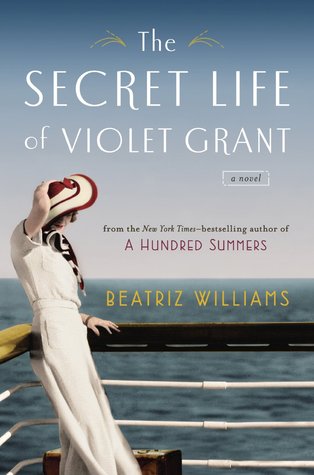
CBR 7 Review 4: The Secret Life of Violet Grant by Beatriz Williams

“I thought, how magical, the first glimpse of snow. By March I would be sick of it, but here in this November instant those tiny flakes swirled with the unspeakable purity of a divine gift.” 

It all began with a suitcase. Lovely and vivacious Vivian Schuyler gets a note for an unexpected package at her little Manhattan apartment in 1964. Retrieving it leads first to meeting Dr Paul, an incredibly beautiful doctor with whom Vivian shares instant chemistry, and more importantly, to her great aunt Violet Schuyler Grant, the woman to whom the suitcase belongs. Dr Paul turns into a rather complicated romantic entanglement. Violet leads to something else altogether - not just the stories and history her illustrious socialite family tried to bury, but a mystery that could help Vivian make her mark at the magazine job she took against her family's wishes.

Violet's interesting history starts in Berlin in 1914, but fills in some blanks preceding that period of time. A country on the brink of war, a woman on the bring of divorce, a meeting of brilliant scientific minds, and a murder.  All these things lie in the story that unfolds from Violet's POV as Vivian researches the past.

I already knew I enjoyed Beatriz Williams' prose, though I haven't reviewed the other book of hers I've read just yet (A Hundred Summers). This is no exception. Williams has a gift for language that is both timely to the period her characters occupy, and timeless in its accessibility. She's also very capable in mixing time periods and balancing the bounce between POVs that a lot of authors attempt and fail at these days. It never feels like she switches between Violet and Vivian just because she feels like she's supposed to; there's always reasonable story motivation. She also does a nice job in the vein of Dan Brown with ending a chapter in a way that inspires a reader to keep going "just one more" till hours have passed.

I vastly preferred Vivian to Violet, but that was bound to be true based on the limitations on women of their respective decades.Vivian is peppy and sharp and witty, written in the vein of a Sherman-Palladino or Whedon character. Violet's more reserved and a hell of a lot more naive, but the circumstances of her life justify it. It took me awhile to warm to Violet, whereas I loved Violet from the first moment she stumbled onto the page. 

The mystery of Violet's murdered husband is a more interesting one than I anticipated, as is the fallout from it. There are a lot of red herrings, but not delivered in a way that felt manipulative. It was set up so that there were plausible possibilities that the reader considered just like Vivian did. There was at least one twist I didn't predict, and that always thrills me.

All in all, definitely a book worth checking out, especially if you enjoy historical fiction!

Tuesday, November 17, 2015

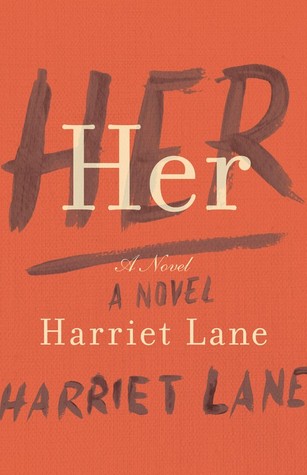
CBR 7 Review 3: Her by Harriet Lane

“I found the final plot twist unsatisfying, as plot twists often are: nothing like life, which - it seems to me - turns less on shocks or theatrics than on the small quiet moments, misunderstandings, or disappointments, the things that it's easy to overlook.” 


That quote was strategically chosen because I found the final plot twist of this DEEPLY unsatisfying. Remember how the last book I reviewed was all about apathy and no vitriol? I've saved that for this entry. It's been three months since I read this book and I can still feel the white hot fury finishing it inspired in me.

There's not a ton I can do by way of plot synopsis, both because of spoilers and the nature of how little actually happens. Nina and Emma, our primary characters and the two POVs our book's narrative bounces between, meet seemingly accidentally and seem to have little in common. It's fairly obvious from the get go that Nina knows who Emma is, while Emma has no memory of Nina.  An odd sort of friendship is manipulated into being by Nina and develops over the course of the story, leading to...well, a lot of spoilers and nothing.

In a non spoiler capacity, this book infuriated me. There are slow burns, and then there's absolutely glacial pacing. Things happen so slowly in this book that I would fall asleep during chapters. The only reason I kept reading at all was that I assumed there was going to be a wham-bang finish to justify how much everyone seemed to be losing their minds over its greatness. Boy howdy was I wrong. The end is such a complete pile of bullshit and questions that I actually threw my Kindle across my couch. The justification for Nina's behavior is practically non existant, and if you're building this story as "sociopath stalks woman" then fine, but that's not the story being told her. The history they tease constantly is nothing at all, and does nothing more than confirm that Nina is a terrible person, which is a thing we learn really fucking early.  And that ending?  Highlight for spoilers: What?? HOW? Who in their right mind thinks it's OK to threaten drowning a toddler and then NOT ACTUALLY TELL YOUR READERS IF IT HAPPENED OR NOT? That's not a cliffhanger, that's just rampant douchebaggery. It would be tragic enough if it ended with Nina succeeding in her mission to be a HORRIBLE SOCIOPATH WHO MURDERS CHILDREN BECAUSE HER DAD WAS A MANWHORE WHO FLIRTED ONCE WITH THEIR MOTHER but to not even tell us what happens??  WHAT THE EVER LOVING FUCK?

OK, so that's that. If you are a person that loved this book, that made it pop up on all my must read lists this summer, that got it on the bestseller list - feel free to leave comments and explain to me why. Because I just don't get it.

Check out more great reviews at Cannonball Read!

CBR7 Review 2: Hidden by Megg Jensen


First review back, and it's not going to overwhelm you folks, since this book left me feeling so incredibly meh that I can't even work up vitriol about it.

Hidden is Book 1 of the Dragonlands series, which hardly matters since I cannot come up with a single compelling reason to continue the franchise. Since it's the first book, like first installments before it, this book is required to do a lot of the heavy lifting of world building and character creation.  Unfortunately, it does neither in a way that matters, though you can tell Jensen is trying. The book opens with a historical chapter, setting up the world in which our protagonists live. The children awaken to the town of Hutton's Bridge with no adults, surrounded by a fog that claims lives.  Our main story begins decades later, when the girl from our prologue, Sofia, is an old woman and great grandmother to our female protagonist, Tressa. The town has remained isolated all this time, and as such its residents have adapted life to being completely shut off from the rest of the world. Youths are paired off by ribbon drawing, designed to prevent inbreeding. If the union produces a pregnancy in 3 months, they are mated - if not, they draw again. Tressa appears to be infertile, making her a social outcast (more on this later), and also unable to be partnered with man she loves, Bastian, who happens to love her back. Every year, 3 people are selected supposedly at random to go into the fog and try to find a way out for their people - no one has ever returned.  On the eve of Tressa's departure into the fog, Sofia dies, leaving the community without their eldest resident, and the only person who was alive when the fog first descended. The following day, plague hits the village, a dead dragon drops from the sky, and Tressa, Bastian, and their friend Connor (who is barely developed at all before events change him) head into the fog.  It's not a spoiler to say that there is a wider world, and the youths discover it.  It's a much more terrifying and evil place than they had anticipated, however, and Bastian and Tressa reunite only to be split apart for their stories to continue.  And really, that's the only reason their stories split - narrative necessity.

That's all I can say without getting into spoiler territory, though spoiling this story really doesn't amount to much. The thing that rankled with me as opposed to merely causing excessive apathy was the treatment of Tressa in the village. I get that in a society where numbers are limited to your own tiny population, the ability to create more humans is an important thing.  That said, bodies aren't the only thing that makes a society work - you also need skilled tradesmen.  Tressa has skills of weaving that she uses to help the village, and she's also one of the only people capable of reading and writing. She's great granddaughter to the only person living (well, temporarily) that was there when the fog fell. She proves time again that she's resourceful, brave, and capable. And yet she's a complete pariah because she's barren?  Fuck that noise. Hell, we're talking about a society where women die in childbirth all the time, and 3 people get murdered by fog every year - let barren women like Tressa help take care of the orphans, which Tressa herself was (mom died in childbirth, dad lost to fog). It just seems like such a stupid waste, and a manipulatively anti-feminist way to create some three dimensionality to a character who doesn't get a lot to work with.

And that, friends, is the apathy motivator for this book - there just isn't a lot of there there. The prose is weak, the character development is competely informed rather than organic, the danger not all that compelling, the world building missing a lot of pieces.  Bastian and Tressa's relationship matters because we're told it does - we're not given enough time with them to see it develop or mean anything. It's also a cheap shot to make Vinya, Bastian's wife, into such a shrew. Setting up romantic roadblocks is fine, and can be interesting fiction, but don't take the lazy way out. She can be flawed and wrong for Bastian without being the personification of every horrible wife stereotype we've ever seen.  Hell, you could even leave the terrible wife things and at least make her a capable and loving mother - there's no reason at all to make her irredeemable.

The only character I really grew attached to is Leo, who we will not be seeing later in this series (not that it would inspire me to pick up another volume) because at least he was charming. Because he's supposed to be mysterious, we also don't have a lot of forced character development for him either, which worked far more effectively than what is done with the rest of the cast of characters.

End result? Skip it. It's not terrible, I'm not mad at it, I didn't throw it at a wall after finishing it because the ending made me mad (I'm looking at you Gone Girl and Her) - I just have no idea why I even finished reading it in the first place.

Check out more great reviews at Cannonball Read!

CBR 7 : Apologies and Amends

As I'm sure the 3 of you who follow this have noticed, I have utterly failed at both my attempt to do video reviews of books for Cannonball Read, and, hey, at doing them at all.  According to Goodreads, I've read 43 books this year, which is much more than the half cannon I committed to.  That said, they don't count if I don't review them, which was my problem last year as well.  At least this time I'm reacting to it before December?

So here's why I'm making this post. I'm going to attempt to get as many of those books reviewed as I can before the end of the year.  I don't recall if that's the actual deadline for CBR, officially speaking, but that's my goal for me. Also, for now, they are just going on here and not the official CBR blog because I can't for the life of me remember anything about how to do those posts there, including my login info.  I'm also just sticking to writing them - doing that one short video took me ages, and I have neither the time nor the desire to get crazy with webcams and makeup and whatnot. So for the moment, my only goal is to review a bunch of books here, in print, by year's end.

The biggest challenge at this point isn't the dedication of time require to review the 42 remaining books (I do have *one* video review up). No, no, my hardest obstacle is going to be remember what the hell I thought about each of these books. Some were not particularly noteworthy at the time I finished them, let alone months after the fact.  You can also expect each of the series that I've read to fill one very long post each.  It seems silly to me to attempt to differentiate between each volume when instead I can do a longer post really delving into the entirety of something like the Codex Alera.

So that's the plan folks!  Tune in over the next month and a half and see how well I do!
-Katie

Friday, January 23, 2015

CBR7 Review 1: Some Kind of Fairy Tale by Graham Joyce

Check out my first video review! We'll see if I need to transcribe it or not. For now, I'm just posting this.

Check out more great reviews at Cannonball Read!

CBR 7 - An intro

What's up!  It's almost February, which means I'm finally going to start posting reviews of the books I read in January.  Trying to keep up this year, instead of getting so far behind that I never catch up.  This year I'm dedicated to a half cannon (I think? I should probably look that up). But this year, I'm going to try something different.

Video Reviews.

For those of you that don't know, I'm an actor by trade. So it appeals to me to film my responses to these books. I don't, however, know how well this is going to work yet. As I sit here, I'm trying to get my stupid webcam software to update so that I can take a crack at the first review.  I'm going to give it a go, and see how we fare. The plan is to post to my YouTube account, and link that video here. If needed, I'll post transcripts along with the video link here, that way y'all have the option to not watch.

So we'll see if this works at all.  It's possible it will be an epic fail, and I'll return to the traditional format I've used for the last several years of CBR. Or this could be awesome. Either way, I plan to actually post my reviews this year, instead of managing two of them once December hits!

Ciao for now.

Thursday, December 18, 2014

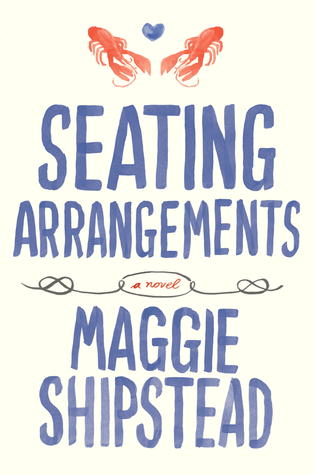
CBR VI Review #2: Seating Arrangements by Maggie Shipstead

“This was truly advanced WASP: how to comfort a wronged wife and mother without acknowledging any misdeeds done or embarrassment caused by loved ones.” 


Man alive did I dislike this book. Sometimes some distance from reading a piece will dull my initial impressions, good or ill, but I still stand by exactly how much I disliked this one.

Seating Arrangements tells the story of some truly terrible people over three days at a New England island estate, preparing for a wedding.  Our principle protagonist is Winn Van Meter, one of the least sympathetic characters I've come across in recent years.  His eldest daughter, Daphne, is getting married to another well to do socialite, named Greyson (really? Greyson?).  While everything has been well planned by the bride's mother, Biddy, things still go awry, as wedding plans often do, even when the people involved aren't terrible.  

Among the sad plots going on in this, Daphne's sister, Livia, is mourning a breakup from the son of her father's greatest (and least deserving) rival; a ridiculous crush that Winn has on one of his daughter's bridesmaids; and God I don't even care enough to say more about these things in summary without ranting about them.

Some spoilers ahead, but if you actually find them shocking, or find that the book is good enough to warrant you caring about knowing what will happen, then maybe just stop here - this review is not for you.

Winn is terrible.  His feud with Mr Fenn (who's first name I cannot be bothered to look up) never actually turns into anything of substance.  The jumps into his past that I suspect were put there to make us care about him only made me hate him more.  He's disrespectful to his entire family.  And God, the sort of tryst with HIS DAUGHTER'S BRIDESMAID.  I cannot get over that, on either side of the relationship.  Agatha is a whore, start to finish, with nothing else going on, and it grosses me out so much to have them be a thing.  It never feels justified, not even enough for me to go "How can you do that to your wife.  I didn't want Biddy to get angry and throw things - I just wanted her to walk out for literally anything else in her life.  Winn is terrifically self involved, a first class narcissist with the self assurance of the nerdy looking but incredibly dumb kid who gets beat up at school every day.  He has everything and values nothing and I just wanted him to die when he fell of that damned roof.  He faces practically no consequences for his consistently bad behavior.

Livia, the other character we're supposed to give a damn about, isn't a great improvement.  She's fairly insufferable about her ideals, completely whiny and unaccepting of her breakup, and naive to a degree that I didn't think was possible.  She grows a bit by the end, which is why she does stand as an improvement, but I didn't really care more for her - just didn't actively hate her.

The only character with POV that I actually cared about was not part of the Van Meter family.  Dominique I found rounded, interesting, compassionate, and realistic.  Whenever we shifted to her I was pleased.  I would have happily boarded a plane with her back to Belgium and followed her story instead of this one.

I don't remember how this book ended up on my To Read list, probably Entertainment Weekly.  It's definitely worth skipping.  The prose is good - this is a writer who understands how to write well.  She just didn't have a story to tell that I cared about, nor characters to hold my interest.