Friday, March 29, 2013

CBR V Review #19: Beautiful Ruins by Jess Walter

“I think so, too. I know I felt that way. For years. It was as if I was a character in a movie and the real action was about to start at any minute. But I think some people wait forever, and only at the end of their lives do they realize that their life has happened while they were waiting for it to start.” 


Beautiful Ruins is a wonderful book, especially if you love old Hollywood, new Hollywood, or Italy.  So really, most people.  It bounces cleanly between timelines, of which there are many, and I never found myself lost.  It's a hard story to sum up, involving the lives of a number of people over a number of years.  From World War II, to the set of Cleopatra, and throughout a number years leading to the present, this book never disappoints.

This is a novel that I loved, most of all, for the lush and delightful prose.  Walter has a beautiful style of writing, such that regardless of plot turnings, I was interested in the next passage just to see how she chose to say whatever it was she wanted me to hear.  A lot of my reading enjoyment is character based (I'll get to that as regards this book in a moment), but it's nice every now and then to let that take a back seat to the writing itself.  That may sound hopelessly pretentious of me, but that doesn't make it any less true.

Walter's book is populated by characters, real and fictional, that you care about.  I think she occasionally labors a little hard to give us the most full picture of each person that she can - some of the information on backgrounds feels a little forced, regardless of how interesting it may be.  However, the characters are still interesting and sympathetic, most especially Dee and Pasquale.  Their time together in the sleepy Italian town was easily my favorite bit of the book, and made me long to see the Italian shores again.

This is a book I would definitely recommend.

Tuesday, March 19, 2013

CBR V Review #18: Sarah's Key by Tatiana de Rosnay

“You get attached to places, you know. Like people, I suppose.”  


This is going to be a bi-polar review because I started out on board and enjoying the book, and then sometime after the halfway point stopped liking ANYONE and wondering how the book hadn't ended yet.  In honor of that duality, I'm going to start the review for the first half, and then transition to the second half. Make of it what you will (what *I* would will is for you not to pick up this book).  Oh, and this is an audiobook, for point of reference.  I really need to take more time to screen the offerings of my library where audiobooks are concerned.

Story opens with juxtaposed timelines - my favorite!  We follow Girl and her family in 1942.  Um, we know her name is Sarah.  It's in the title.  Is there really a reason we can't identify her or her family members by name?  No?  Not gonna do that till much later?  Ok, fine.  Anyway, Girl/Sarah and her fam are rounded up by French police as part of the historical Vel' d'Hiv' roundup, with Girl/Sarah locking her brother in a hidden cupboard, thinking she'll be back to get him and he'll be safe.  You know this is going to end tragically, but her desperate hope and naivete still hurts.  In present day, we're following Julia Jarmond, an American living in Paris in 2002 with her precocious daughter Zoe and her obnoxious French stereotype husband, who's name I can't spell.  Bertrand I think.  That's the bitch of audiobooks, folks - spelling.  Anyway, she's researching the Vel' d'Hiv' roundup for her magazine, as it's the 60th anniversary.  Ok, cool, so they are tied together by that.  

As the story progresses in 1942 with the huddled, starving masses of Jews as they are held and then moved to internment camps before eventually being sent to Auschwitz, we learn in the present that Bertrand's grandmother's apartment is going to be the new home of Julia and family...and used to be the home of Sarah and hers.  Dun dun DUUUNNNN!  Seriously, though, this is telegraphed early.  Regardless, Julia's journey to discovering this is entertaining, and provides some interesting historical information on the roundup.  In the meantime, Sarah's story moves along with all the sadness and horror you would expect, until it meshes with some history of Julia's in-laws (no spoilers, though you will see this coming from MILES away)...and then Sarah disappears from our narrative.

Y'all, this is where this train goes off the rails.  Now all my focus is on Julia, and the more time I spend with Julia, the more I want to punch her in her selfish face.  See, Julia is captain of the subplot brigade.  She NEEDS TO KNOW what happened to Sarah. It's not enough to dig through her in-law's trauma and know that Sarah and her family lived there and then suffered like so many countless Jews did at the time.  She must TRACK. HER. DOWN.  Y'know, because a woman who managed to live beyond the Holocaust desperately wants to hear your generations removed guilt about what she had to live through in the first place.  This involves invading a bunch of people's lives, upsetting her own family, and multiple trips to other countries.  


Added bonus?  OH HEY!  There's a pregnancy subplot that DOESN'T MATTER AT ALL.  Which tied loosely to an adultery subplot that ALSO didn't matter.  The beauty of the pregnancy subplot is how completely I hate everyone who discusses it.  This is a woman who has had repeated miscarriages and is in her late forties.  But the reaction to her pregnancy is for her husband to say he's "too old to be a father" and the few other people she tells to say "OMG HAVE BABY!!"...no one, not once, pauses to say "Um, do you think this might be dangerous for you and the fetus growing inside you?"  Never.  The abortion debate is on in full (and A COMPLETE WASTE OF TIME) but not a single person addresses the very real risk situation that Julia is in by being pregnant at all with her previous issues and current age.  THIS MADE ME SO MAD.  Flames...on the side of my face...

Also, I hate Julia.  She never stops to think of a single person other than herself and her own misguided guilt.  She tracks down people who don't know things and forces her knowledge on them, for THEIR OWN GOOD.  And it never occurs to her that, oh hey, maybe they didn't know all of these things, and maybe they don't want to know them.  YOU DUMB T**T.  The cherry on this fucked sundae is a last act shoehorned romance that feels about as natural as a salt water enema.  Oh, and spoiler alert?  The baby she doesn't abort?  SHE NAMES HER SARAH.  That's total normal, to name your baby after a Holocaust survivor you never met who found her dead baby brother in a cupboard in your in-law's apartment.  YOUR OBSESSION ISN'T WORTHY OF ALL THE THERAPY OR ANYTHING.

I feel like reading the end of this book was like watching Smash.  Is there a term for hatewatching that applies to reading?  Hatereading?  Or, wait, this was audio.  Is it hatelistening?  I don't know.  But people passing me on the highway must have thought I was having an episode from all the screaming I did at this book in my car.

There are about a billion better books out there to read if you want good historical fiction based in and around the Holocaust.  I have no idea if there are other good pieces about the Vel' d'Hiv' roundup, but unless you are completely obsessed with that specifically (in which case you and Julia can be besties!!  ...somewhere far the fuck from me) then you are better off reading something else.

Monday, March 18, 2013

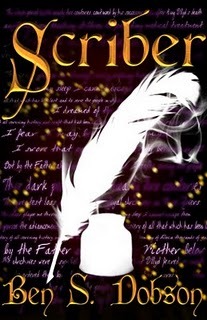
CBR V Review #17: Scriber by Ben S Dobson


Scriber is a book that sneaks up on you.  I borrowed this for free from the Kindle Lending Library (thank you Amazon Prime!) and I always approach those books with a certain amount of hesitation.  Stuff being offered for free can be pretty hit or miss.  The first quarter of this book, I was pretty sure I had found a miss here.  Still, I powered through and was rewarded with a thoroughly engaging story and a climax that truly got to me.

Scriber tells the story of Dennon Lark, a disgraced scholar hiding away in a tiny town, hoping to be forgotten, buried in his own cowardice.  Soon, a group of rebels attacks the town, and his quiet life is disrupted as he is pulled into a conflict he wants no part in.  His travels begin with niece to the king, warrior Bryndine Errynson, and her troupe of disrespected female soldiers - a journey that will take them throughout the kingdom to piece together a lost history and try to save them all.

When I say this book had a slow burn, I mean it.  It also didn't help that I moved onto this directly from Kingkiller Chronicles, with which it shares some similarities.  The characters start out painted in very broad strokes, and Dennon begins the story as one of the least likeable leading men I've read in awhile.  He's whiny and cowardly, and I was more than content with the idea of someone killing him off.  However, he grows, and you learn more of why he is the way he is.  More importantly, however, is the gradual introduction and development of the women he travels with, especially Bryndine.  These are characters you want a series about.  I'd read the tales and travels of Bryndine's Company.  You get very attached to these women, and to the incredible warrior who leads them.  I have no idea if Dobson has read Game of Thrones, but I'm hedging my bets that he has, and that Bryndine owes a lot to Brienne from that series.  They are both women of enormous stature, with incredible fighting skills, masuline features, and short cropped blonde hair.  They both have trouble finding any respect for their skills in societies that expect only men to possess them.  I saw Gwendolyn Christie in my head as Bryndine for the whole of the book, which is not an insult, merely an observation.

If you had told me in the early chapters that by the end I would be weeping in public, I would have thought you crazy.  Nevertheless, this is what occurred.  It's a solid piece of fantasy writing, and one I would encourage you to tough out.  It's worth the effort.

CBR V Review #16: The Wise Man's Fear by Patrick Rothfuss

“Knowing your own ignorance is the first step to enlightenment.” 


The quote I've chosen for this, the second volume of The Kingkiller Chronicles, Day 2 of Kote's retelling of his life as Kvothe, is really the overarching theme to this book.  Normally I pick a quote I just really like; sometimes it's because of how the line applies to the main character.  But here, I feel that this quote really outlines Kvothe's journey through WMF.  This is a book where Kvothe's sometimes willing ignorance gets him in to all kind of trouble, but also motivates his journey towards the path to greater enlightenment.  Wow, that sounded pretentious, and it's totally not, but it's still true.  Kvothe does some stupid things to start out, but once those kickstart his journey, he ends up learning so many important things he had lacked before.  It's all setting up a beautiful path to wherever the brilliant Patrick Rothfuss is taking us in the final book.

Kvothe's story here begins and ends at his beloved University, but it's where he travels in between that gives the story the most substance.  Rothfuss isn't content to leave his protagonist in one place for so long (which is doubly logical due to his Rue background - troupers seldom plant roots anywhere).  Still, the University is central to who Kvothe is, and his search for ever more knowledge.  I'm glad that we got to spend more time with him there.

At University, Kvothe's ongoing feud with Ambrose Jackis (one of literature's biggest douchebags) escalates.  As an added bonus, his previous clash with him, the one that motivated his first naming of the wind, comes back to bite him in the ass.  As such, it's not long before Kvothe finds himself taking some time off to go visit a potential patron, the Maer.  While helping him with his health and to woo a lady, Kvothe starts to learn some important things about politics, courtly graces, and the right way to deal with people in power.  From here, he is sent on a journey to stop some bandits.  This trip leads to sexual education with a fairy, learning to fight and speak like an Adem mercenary; and his return trip gets him steps closer to the answers he seeks, even if he doesn't realize it yet.  This last is a piece of fan theory that I'll keep from this review, but it's important just the same.

It took me forever to write this review because I adore this book, and I knew I couldn't do it justice.  Everything about it is wonderful.  I find it impossible to put this series down, and the culture gets into my brain enough that I'll do things like cursing in their idioms (ie Merciful Tehlu, or Blackened Body of God) instead of in my own.  I love watching Kvothe learn and grow as a character.  Tensions also ratchet up in Kote's timeline, but there's still a lot of mystery surrounding Bast and his motivations to return his Reshi to his old self.

This book also introduces us to one of the most devious villains in fiction - the Cthaeh.  The Cthaeh exists in the realm of the Fae, and knows everything.  I mean that literally - it knows every single future pathways that is possible.  If you come into contact with it, it will guide you towards whatever the most destructive pathway is, simply because it can.  The quiet malice of something like that is really effective.  

I love this series and can't wait for the next book. Pick it up ASAP.

Thursday, March 7, 2013

CBR V Review #15: People of the Book by Geraldine Brooks

“A book is more than the sum of its materials. It is an artifact of the human mind and hand.” 


This audiobook was like a study in accents.  I'd definitely recommend listening instead of reading it, since it's fun to hear all the different cultures represented.

People of the Book is the story of The Sarajevo Haggadah, an illuminated prayer book that survived hundreds of years and frequent brushes with its own destruction.  It's loosely based on fact - the Haggadah is a real book, one of the oldest Sephardic Haggadahs in the world.  The book was created in Barcelona around 1350, and currently resides in the National Museum of Bosnia and Herzegovina in Sarajevo, both of which are facts presented by the book.  Many of the events in this book did involve the Haggadah, but the details are mostly, if not entirely, fictitious.  The infusion of the actual history involved is what makes this book such a compelling read.

The narrative is framed using one of my favorite devices - starting in a contemporary setting and jumping back to reveal pieces of the past as it goes along.  In this case, our story starts in 1996 with Hannah Heath, an Aussie conservator hired to preserve and research the book, which has been found in Sarajevo.  The history of the book is cued by different things Hannah finds within the Haggadah and researches, things like a stain or a hair.  Each time she investigates something of that nature, it sets the narrative on the path of that segment of the book's history, starting with the first section in WWII, and gradually moving all the way back to Barcelona and the book's creation.  In between, you get to see Hannah's personal journeys, both related to the book and not.  There's also some closure at the end that is completely fictional, and I wager was put in there for the sake of suspense.  I have mixed feelings about it, but for the sake of preventing spoilers, I'll leave it at that.

Hannah is an excellent character, and a wonderful thread to keep the whole tale together.  Her relationships, even the ones unrelated to the book like the one with her mother, feel very real.  I was connected enough to her throughout to get protective of her later in the book, and I think that's telling.  There are a LOT of characters in this to keep straight, but since they are all contained within their own pieces of the story, it's never really hard to remember who is who.

My one complaint with this book is its length.  I have no idea how long it is in terms of pages since I listened to it, but it's one of the longer audiobooks I've enjoyed.  This by itself would be no problem - I read books of great length on the regular.  The issue here is that it *feels* long.  I'm not sure if it needed fewer pieces to the story, or less time spent on some of them, or what.  But I found my attention drifting from time to time, and sometimes checked to see just how far along I was in the book's progression.  That doesn't make it a bad book, but it kept me from giving it 5 stars.

If you are a fan of historical fiction, you'll probably dig this.

Wednesday, February 27, 2013

CBR V Review #14: The Name of the Wind by Patrick Rothfuss

“It's like everyone tells a story about themselves inside their own head. Always. All the time. That story makes you what you are. We build ourselves out of that story.” 


This is going to be an incredibly glowing review, so prepare yourselves.  It's my second read through of this fantastic fantasy book (which is volume one of The Kingkiller Chronicles) and I loved it even more the second time.  I am an unabashed fangirl of this series.  I belong to a group that discusses theories on what has happened and what is going to happen.  I follow Rothfuss's fabulous blog and facebook page.  And I desperately want a set of talent pipes, but I'm such a nerd that I feel badly buying them for myself because I feel they need to be earned.  So this review is going to be filled with nothing but praise, and all of it well deserved.

The Name of the Wind is a fantasy epic following the story of Kvothe, who is a man of many names and stories.  The narrative is framed by our hero, who is currently in hiding as an innkeeper named Kote (in a beautiful play on words, this name means "disaster" in Siaru, one of the languages in the world this is set in).  Kote comes upon a man one evening known as The Chronicler, and is compelled to tell his story and set the record straight.  He tells Chronicler that he will tell the story over three days, and that nothing is to be omitted or changed in any way - this is *his* telling.  The books, then, are set with each volume of the trilogy representing a day of the story being told, with some bouncing back and forth between Kvothe's story, and what is happening to Kote, Chronicler, and Kote's student Bast during the telling.  The Name of the Wind is Day One, and what a day it is.

In Kote's timeline, war rages and times are tough.  We know from Bast, who is of the Fae, that Kote is not the man he used to be, though we aren't really sure why.  An innkeeper's life seems a strange choice for a man of legend, whose stories are told over fires countless times till any seed of truth seems to be lost.  There are terrible things on the horizon in this present, with horrible demon spiders called Scrael appearing unexpectedly.  But the thing that really pulls everything along is the story that Kote is telling, the story of our beloved Kvothe.

I've heard a lot of people hate on Kvothe.  He's arrogant and impulsive.  Sure, that's true, but I find it to be part of his charm that he's flawed.  Kvothe's story begins with the Edema Ruh, traveling troupers who are his family.  Kvothe's Ruh roots are essential to the story, both because his upbringing shapes who he is, and because what happens to his troupe is the catalyst for everything that comes after.  Kvothe is a brilliant boy, the type of kid you only have to show something once and he's got it.  An arcanist travels with the troupe for a time, and this lights a fire of learning under Kvothe.  He wants desperately to attend the University and learn more, and it's obvious that he's more than capable of handling the workload.

I hesitate to go further into the plot.  It's such a beautiful story to discover piece by piece, layers of success on foundations of tragedy.  Kvothe's journey is far from a simple one, and it's a joy to see the world through his eyes.

Rothfuss has done such a beautiful job in world creating here.  I'm a big fantasy reader, and the more thoroughly developed the world is that I'm being brought into, the happier I am.  Rothfuss has gone so far as to have a currency converter program you can play with on his website - THAT is some serious dedication to world building.  The cultures, currencies, languages - all of it feels organic and complete as you read, like you could really go and live there, study at the University, listen to the musicians at the Eolian. 

Oh, the music.  I have to mention that.  I am a musician - I've been a singer most of my life.  Kvothe's passion for music is one of my favorite things about the series.  The culture of the musical world in this book is rich and vivid and I adore it.  I want to go listen to people play in the Eolian.  I want to try for my talent pipes.  I want to throw back a tankard of sounten with Deoch and Stanchion.  It's not a common thing to pay so much tribute to music, and this series does it in the best ways possible.

The characters deserve a mention, too.  Everyone in this is so well developed, I feel like I know them.  Well, except maybe Denna, but how well does anyone know the mysterious, captivating, cruel (but not unkind) object of Kvothe's fascination?  Each person who crosses paths with Kvothe feels real.  They have histories, and cultural ties, desires and fears.  They are real people, characters that could each have their own book to tell their story if they wanted, as I have no doubt that Rothfuss knows what those stories are somewhere in that labyrinthine mind of his.  And Kvothe...oh my Kvothe.  I adore him, flaws and all.  He may be one of my favorite characters in literature.

This book, and the series thus far (the final day, aka the book The Doors of Stone, is as yet unpublished) ranks among my favorite books of all time.  If you are a fan of fantasy, or even just a fan of good literature, I implore you to run out and buy this book immediately.  Go to Amazon.com and order it for your Kindle.  Go to B&N and pick up a hard copy.  I don't care what form of media you use, but get it now - you're only cheating yourself by skipping it.

Monday, February 18, 2013

CBR V Review #13: I am a Genius of Unspeakable Evil and I Want to Be Your Class President by Josh Lieb

“Crime is for poor people. You don't need to rob the bank if you own it.”


Another audiobook.  It took me a long time to think of what I wanted to say about this book, and I still don't really have an answer.  It left me completely apathetic.  It's not good, it's not bad - it just is.

Genius is about Oliver Watson, an evil genius 12 year old who plays the idiot in his daily life to hide the fact that he is the third richest person on earth.  In an effort to earn his father's approval (something he continually denies needing), Oliver runs for student government, using all his evil skills and connections to succeed. 

Reviews on GoodReads would suggest this book is totally hilarious.  I didn't really find it to be so.  Oliver is profoundly unlikeable, and since he is both our narrator and protagonist, it makes it a little hard to give a crap about his story.  A lot of the humor is fairly obvious, and I think I expected something a little more subversive from someone who works for The Daily Show.  It's very...safe comedy.  I found my mind wandering during passages.  I'd be more interested in a book that explored Oliver and Tatiana, as her involvement in any scene made me more interested in the proceedings.

In terms of audiobook review, the reader does a great job.  He employs a large number of voices for the characters, and generally to great effect.  I HATED the interstitial music.  I have no idea why it was there, or how they chose when it was employed, because it seemed to just play sometimes for no reason at all.  And was annoying. 

Best scene?  The scene between Liz Trombley and The Motivator.  Every beat of that is comic gold and I loved it.

I'm not even giving this book stars because I don't wanna.  I don't want it to be compared with other things I've rated with whatever star number, because I genuinely don't feel feelings about this.  Maybe I was just in the wrong frame of mind when I played it, I don't know.  This book is beige.